Nexus
Nexus is a hardened infrastructure blueprint demonstrating how to ingest and persist sensitive data inside a strictly isolated AWS environment. Built entirely with type-safe AWS CDK, the system eliminates public network exposure while preserving scalability, backpressure control, and operational simplicity. It is designed as a reference architecture for regulated workloads requiring deterministic data flow and least-privilege access boundaries.
Technical Stack
Executive Summary
Nexus implements a secure, event-driven ingestion pipeline engineered for environments where public internet exposure is unacceptable. The architecture prioritizes deterministic data movement, network isolation, and infrastructure reproducibility through fully automated AWS CDK deployment.
- End-to-end private data flow — no Internet Gateway, NAT Gateway, or public endpoints.
- Event-driven ingestion using S3 notifications and SQS buffering to absorb traffic bursts.
- Controlled compute scaling via polling-based ECS Fargate worker.
- Credential lifecycle management through AWS Secrets Manager with runtime injection.
- Cost-aware resilience design balancing Multi-AZ compute with Single-AZ database trade-offs.
Zero-Trust Network Topology
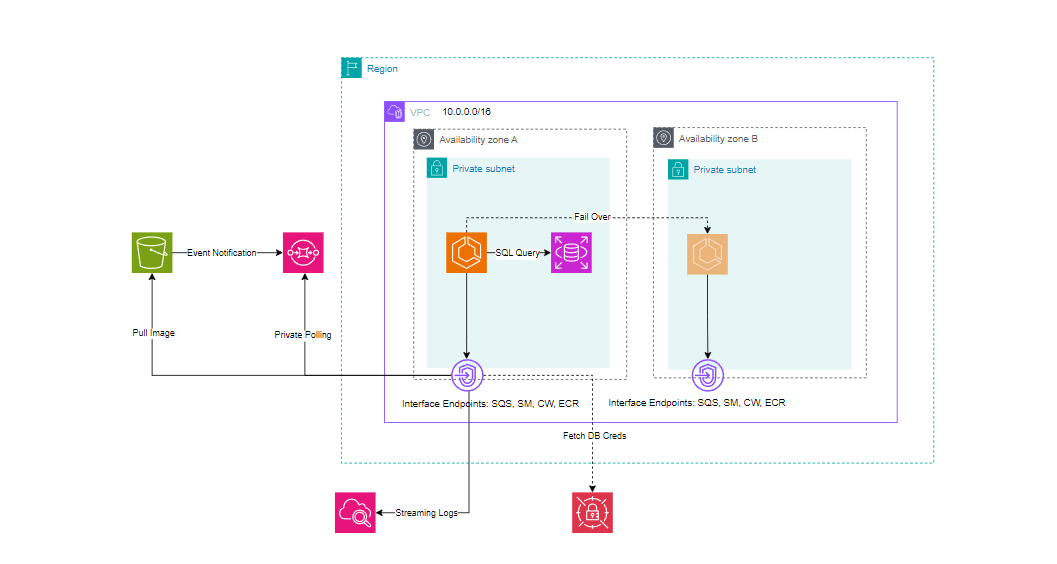
The system follows a portless, endpoint-only communication model. All compute and persistence resources reside in PRIVATE_ISOLATED subnets. Access to AWS-managed services occurs exclusively through Gateway and Interface VPC Endpoints, ensuring traffic never traverses the public internet.
- PRIVATE_ISOLATED subnets across multiple Availability Zones.
- Gateway Endpoint for S3 and Interface Endpoints for SQS, ECR, CloudWatch, and Secrets Manager.
- No public IP assignment, no bastion hosts, and no inbound security group exposure.
- Least-privilege IAM task role scoped strictly to S3 read, SQS consume, secret retrieval, and database connectivity.
- PostgreSQL 17.6 on Graviton-based instance for optimized price-to-performance efficiency.
Event-Driven Processing Model
The ingestion pipeline separates storage, messaging, compute, and persistence layers to prevent cascading failure and to maintain throughput control during load spikes.
- File upload to S3 triggers asynchronous event notification.
- SQS acts as a durable buffer, decoupling ingestion rate from processing rate.
- Fargate worker polls the queue to maintain deterministic concurrency limits.
- Message deletion occurs only after successful database persistence.
- Architecture supports horizontal compute scaling without direct database coupling.
Resilience & Operational Trade-offs
Nexus is intentionally designed as a Phase-1 production baseline, balancing availability with cost constraints while remaining upgrade-ready for high-availability expansion.
- ECS service deployed across multiple Availability Zones for compute redundancy.
- RDS configured Single-AZ for cost efficiency, upgradeable to Multi-AZ via configuration change.
- SQS ensures durability and retry semantics for transient failures.
- VPC endpoints provisioned across zones to avoid single-datacenter dependency.
- Infrastructure defined entirely in AWS CDK for reproducible deployments and controlled change management.
Security & Identity Controls
Security is enforced through layered network isolation, identity-based access, and managed secret injection. The design eliminates static credentials and reduces the attack surface to IAM-bound service identities.
- No long-lived database credentials stored in source control or container images.
- Secrets injected at runtime from AWS Secrets Manager.
- IAM task roles restrict service permissions to exact resource ARNs.
- CloudWatch logging enabled for worker visibility and audit tracing.
- All internal service communication remains inside AWS private networking boundaries.