ToraBeta
Tora is an AI-driven calisthenics coaching application that replaces traditional workout tracking with natural language interaction. Users log workouts via chat, which are processed by AWS Bedrock into structured training data, stored in Neon Postgres, and mapped into a skill tree progression system. The backend is built on a serverless, event-driven architecture optimized for scalability, low operational overhead, and controlled AI inference costs.

Technical Stack
Cloud Architecture Overview
Serverless, event-driven architecture designed for low operational overhead and horizontal scalability.
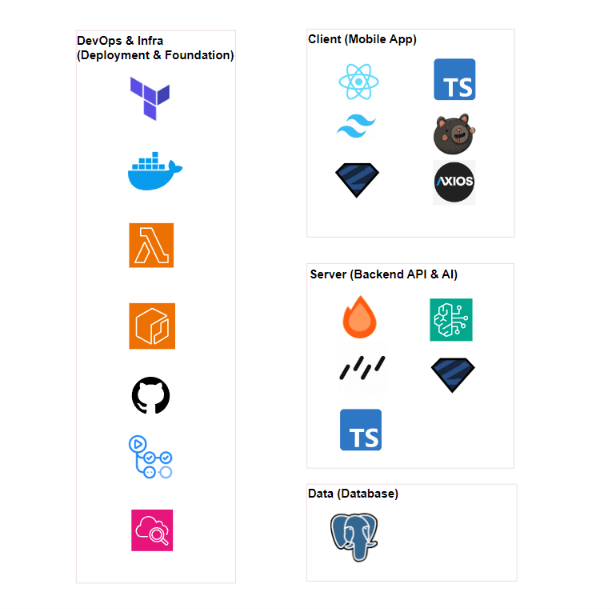
- 1. Client (Mobile App): User interaction, UI design system, state, and client-side logic. (Stack: React Native + Expo, Expo Router, NativeWind, Zustand, Axios & Zod)
- 2. Server (Backend API & AI): Application processing, validation, database querying, and direct orchestration with artificial intelligence. (Stack: Hono Framework, Drizzle ORM, AWS Bedrock SDK [Amazon Nova Lite & Amazon Titan], Zod Validation)
- 3. Data (Database): Data persistence, relational integrity, and planned semantic indexing. (Stack: Neon Postgres, pgvector extension [Upcoming])
- 4. DevOps & Infra (Deployment & Foundation): How the serverless application is built, provisioned, and hosted in the cloud. (Stack: Docker, AWS Lambda, Terraform, ECR, CloudWatch, GitHub Actions)
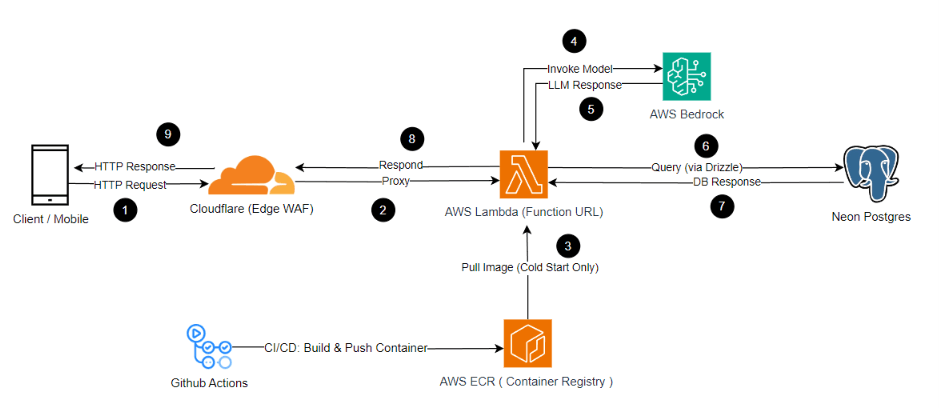
Serverless Cloud Topology
Strictly serverless, event-driven network deployment mapping out cloud boundaries and secure access paths across AWS and Neon.
- 1. Client / Edge Domain: The user's mobile app (Expo/React Native Client) communicating over secure HTTPS directly to AWS.
- 2. AWS Cloud Domain: Containerized compute, logging, and serverless AI. Connects Amazon ECR (Docker registry), AWS Lambda (Hono serverless compute), Lambda Function URLs (cost-controlled public endpoints with built-in CORS), AWS IAM execution roles (secure, keys-free access to Bedrock APIs), AWS Bedrock (Serverless Nova Lite LLM), and Amazon CloudWatch (automated execution monitoring).
- 3. Neon Cloud Domain: Separate serverless database cloud hosting the primary Neon PostgreSQL instance, connected securely via PostgreSQL TCP connection.
Backend & Serverless Design
Lambda-first architecture optimized for stateless execution and cost efficiency.
- Stateless AWS Lambda functions for all core API operations
- Event-driven workout ingestion pipeline via chat requests
- No persistent server layer (eliminates ECS/EKS overhead)
- Cold start considerations mitigated via lightweight handlers
- Separation of concerns between auth, chat, and analytics functions
AI Inference Pipeline (AWS Bedrock)
Cost-controlled LLM pipeline for natural language workout parsing and coaching feedback.
- AWS Bedrock (Nova Lite) used for structured workout extraction
- Token-based cost model with credit abstraction layer
- Input/output separation for cost tracking and optimization
- Prompt engineering tuned for deterministic workout parsing
- Feedback generation tied to skill tree progression rules
Event-Driven Workout Processing
Decoupled ingestion pipeline ensuring reliability and scalability under variable user load.
- User submits workout via chat message
- Lambda processes and forwards to Bedrock for parsing
- Structured output persisted in Neon Postgres
- Optional vector embedding generation for memory layer
- Asynchronous design avoids blocking user interaction
Data Layer & Persistence Strategy
Hybrid relational + vector storage model optimized for structured tracking and semantic recall.
- Neon Postgres stores users, workouts, credits, and progression state
- Vector embeddings enable long-term training memory retrieval
- Schema designed around movement categories and skill tree states
- Efficient read patterns for dashboard and analytics queries
- Separation of transactional vs semantic data storage
Scalability & Performance Design
System designed for horizontal scaling without infrastructure rework.
- Lambda auto-scales per request load
- Bedrock inference scales independently of application layer
- Database scaling delegated to Neon serverless Postgres
- Stateless backend ensures no session affinity requirements
- Chat-driven workload naturally batches into short-lived executions
Cost Engineering & FinOps Model
Architecture explicitly optimized around per-token LLM economics and serverless billing models.
- LLM costs abstracted into credit system (1 credit per ~3,000 tokens)
- Bedrock dominates variable costs (primary scaling risk factor)
- Lambda and Cloudflare operate near-zero cost at small scale
- Neon Postgres free tier minimizes baseline infrastructure cost
- Designed for predictable margin per AI interaction
Security & Cloud Hardening
Minimal attack surface design using managed services and strict separation of concerns.
- No exposed servers or persistent compute instances
- All API access routed through authenticated Lambda endpoints
- Cloudflare provides TLS termination and edge protection
- Neon handles database isolation and managed security patching
- Bedrock inference executed within AWS-managed secure boundary
Edge WAF / DDoS Mitigation
Lightweight edge authentication proxy using Cloudflare Workers as a network-level trust boundary, ensuring all traffic must pass through Cloudflare before reaching the API.
- Intercepts all API requests — every client request hits the Cloudflare Worker first (edge location) before reaching the origin.
- Injects a shared secret header — the worker signs the request using a token bound to the worker's environment.
- Forwards to the origin server — clones the original request and proxies it to the backend endpoint.
- Origin validates the signature — the backend checks the header with a timing-safe comparison to ensure the request came through the edge proxy, not directly.
- Infrastructure managed via Terraform — the worker script, environment bindings, and public edge subdomain are fully provisioned as code.
IaC & Environment Topology
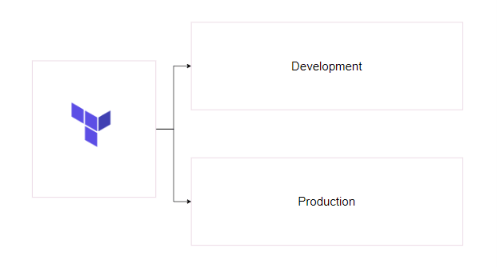
Development (Local) vs. Production (Cloud) environments engineered for hot-reloading development speed and high-scale cloud execution.
- 1. Development Environment (Local Host): Fast, hot-reloading sandbox. Client runs locally via Expo Go on Wi-Fi IP, server API runs via tsx watch directly on Node.js (localhost:3000), database connects to Neon Dev Postgres, and Bedrock calls use a local .env file containing AWS credentials.
- 2. Production Environment (Cloud Host): Secure, serverless deployment. Client is built via Expo EAS for app stores, server API is compiled and packaged as a Docker container running on AWS Lambda with a Function URL (HTTPS), database connects to Neon Prod Postgres, and Bedrock calls authorize through IAM roles managed by Terraform (/infrastructure).
Docker Containerization
Containerized backend components for consistent runtime behavior across environments.
- Docker used for packaging backend services and dependencies
- Consistent local and cloud execution environments
- ECR-compatible image builds for AWS deployment workflows
- Isolated runtime environments for reproducibility
- Simplifies dependency management for Lambda-adjacent services
CI/CD Pipeline & Build Algorithm
Fully automated GitHub Actions workflow packaging backend updates as containerized Docker images and deploying serverlessly to AWS Lambda on every code push.
- 1. Git Trigger Check: Automatically initiated on any push to the 'main' branch that changes files in the 'server/**' directory.
- 2. Runner Initialization: Launches an isolated Ubuntu Linux virtual runner environment and checkouts the active repository branch.
- 3. AWS Authentication: Connects to AWS securely via decrypted GitHub Secrets and logs into your private AWS Elastic Container Registry (ECR).
- 4. Docker Compilation & Tagging: Compiles the TypeScript Hono API and builds the Docker container from public.ecr.aws/lambda/nodejs:20, tagging it with both the commit SHA and 'latest'.
- 5. ECR Image Ingestion: Uploads and registers both image tags to your AWS repository.
- 6. Serverless Cloud Deploy: Executes an asynchronous aws lambda update-function-code command via the AWS CLI to point the active Lambda function to the newly uploaded container image.
